CAMLIS · November 14, 2025

Adversarial ML Attacks on Financial Reporting via Maximum Violated Multi-Objective Attack

Adversarial ML Attacks on Financial Reporting via Maximum Violated Multi-Objective Attack video thumbnail
Why it matters

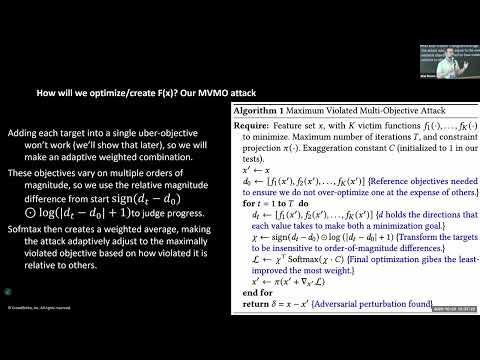
Edward Raff and collaborators introduce Maximum Violated Multi-Objective attacks for manipulating financial statements while simultaneously reducing model-generated fraud scores. Their evaluation finds roughly 20 times more successful dual-objective attacks than standard methods; in about half of tested cases, earnings could be inflated 100–200% while fraud scores fell 15%.

My takeaway: Red-team financial models against realistic combinations of attacker goals instead of optimizing one metric at a time. Validate model outputs against accounting constraints and source evidence, monitor coordinated feature shifts, and retain independent audit controls rather than treating a low fraud score as assurance.
Keep exploring

More curated notes connected through AI Red Teaming and Agent Security.

OpenAI News · framework

OpenAI’s Frontier Governance Framework

OpenAI's 22-page Frontier Governance Framework maps its frontier-model processes to California's Transparency in Frontier AI Act and the EU AI Act's general-purpose AI code. It documents lifecycle risk assessment, cyber-offense and other risk tiers, mitigation and residual-risk decisions, critical-incident handling, security risk management, model reporting, external review, responsibility allocation, and change control.

OWASP GenAI Security Project · guide

OWASP Top 10 for Agentic Applications for 2026

OWASP's community guide organizes agentic-system risk into ten categories, including goal hijacking, tool misuse, identity and privilege abuse, memory poisoning, insecure inter-agent communication, cascading failures, and rogue-agent behavior. It provides a shared taxonomy and mitigation starting point rather than a certification checklist or evidence that a deployed system is secure.

OECD.AI Wonk · guide

A five-step roadmap to closing the AI evaluation gap

The roadmap addresses evaluation results that overstate real-world performance or fail to transfer across deployment contexts. Its five steps balance standardized and local tests, evaluate throughout the lifecycle, build qualified assurance and communication capacity, tailor tests to each value-chain actor and technology, and use a coordinated, trusted process for updating methods.